Projects & Research
PatchWork @ StarkHacks
Won Best Use of AMD Tech at StarkHacks.
PatchWork is an on-device AI system for robot arms that detects failed manipulation tasks, diagnoses the issue, adjusts the skill program, and retries autonomously without cloud dependency, retraining, or human intervention. Built to reduce costly robot downtime in fulfillment environments, PatchWork translates natural language commands into executable robot skills and verifies each step in real time using a vision-language model on AMD hardware. I built the hardware-facing execution layer, including motor calibration, USB/serial device mapping, teleoperation validation, record/replay execution, and runtime robot API controls for autonomous skill patching.

CADENCE
Cadence is a wearable that generates music with hand motion. An ESP32 with a 6-axis IMU sensor captures accelerometer and gyroscope data, which is processed into stable motion features and mapped to musical notes, timing, dynamics, and instrument changes in Ableton Live via a Python MIDI pipeline. The project focuses on normalizing noisy human motion into reliable control signals, using sensing, filtering, and feature extraction techniques common in robotics and human-in-the-loop control systems.


Diamond Anvil Cell - Zhan Research Group
Engineering and designing a high-pressure diamond anvil cell system rated to 1 gigapascal to study ice crystal growth under extreme conditions for cryopreservation, cell therapy, and organ/tissue surgery applications. All research done in a group of four under Dr. Li Zhan of Purdue University.
I have designed & manufactured copper blocks that deliver cool current to a gasket which houses the ice sample, nested between 2 diamond jaws. In figure to the right.
I modeled and CNC-machined these 2 copper components using Design for Manufacturability (DFM) principles to allow for tolerance control, and assembly fit within the moving system.
Diamond Anvil Cell Reference

Grey Support = Copper Block, Credit: MachineDesign
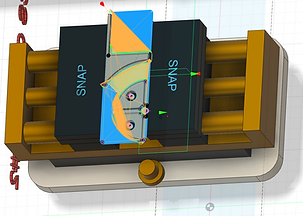

Used Fusion to CAM/CAD the Model

LightHouse: #18213886
81% of women and 43% of men reported experiencing some form of sexual harassment and/or assault in their lifetime - yet only 20% of assaults are reported. I created a device, LightHouse, which is a discreet, inexpensive personal safety device with an activating motion (toe curl) that can alert authorities even when under attack.
Lighthouse is a low-cost ($5.99), embeddable sensor and alert system located on the vamp of a shoe. Lighthouse is activated by the user curling their toes, initiating an alert that shares the user's live location with a chosen emergency contact through a mobile app. LightHouse aims to lower the barriers and hesitation to call for help during an assault. The device thus far has shown a greater than 90% activation success rate.


Phlexor
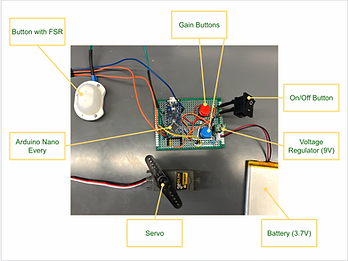
As a result of stroke, millions across the United States struggle with limited upper extremity function, specifically limited hand dexterity. Hand exoskeletons are designed to improve and restore hand motor function as well as quality of life. However, providing robust and intuitive user control remains challenging due to reliability issues or limited applicability to daily life scenarios. Phlexor’s control method addresses these obstacles by using a force sensor placed within a button on the palm which utilizes the residual isometric grip force of the ring and little finger to actuate the remaining three fingers. Phlexor uses a differential mechanism consisting of a single bevel gear and three spur gears to power separate rack-and-pinions, stimulating the natural postural synergies of the hand and supporting multiple variations of grasps with a single servo motor. A spring-driven slider placed on the dorsal side of the hand allows the user to mechanically fix the thumb in three different positions, enabling them to create opposition when needed. To improve the user’s donning and doffing experience, Phlexor is designed to attach to the dorsal side of the hand using compliant clasps. The inexpensive design prioritizes a lightweight and compact profile on the hand and arm while simultaneously achieving consistent movement. Future studies look to validate the functionality of Phlexor to both restore the user’s ability to perform acts of daily living and rehabilitate natural biomechanical functionality.

Prosthetic Interfaces
Built w/ Dr. David Quintero
This interface allows engineers to adapt motorized prosthetics inexpensively, and quickly. It streams live force and finger kinematics data to provide the user with an easy way to set a hand-grasping intention.
Open-Sourced for affordability and to increase customization of prosthetics among other amputees, engineers, and orthotists.